Everything parents, students, and staff need to know about school closure announcement times, who makes the call, and how to get notified first.
Every winter morning when storm clouds gather, millions of parents, students, and teachers ask the same urgent question: what time do schools announce snow days? Whether you need to arrange emergency childcare, reschedule a commute, or simply set your alarm with confidence, knowing the exact window when school closure decisions are made can save you hours of uncertainty.
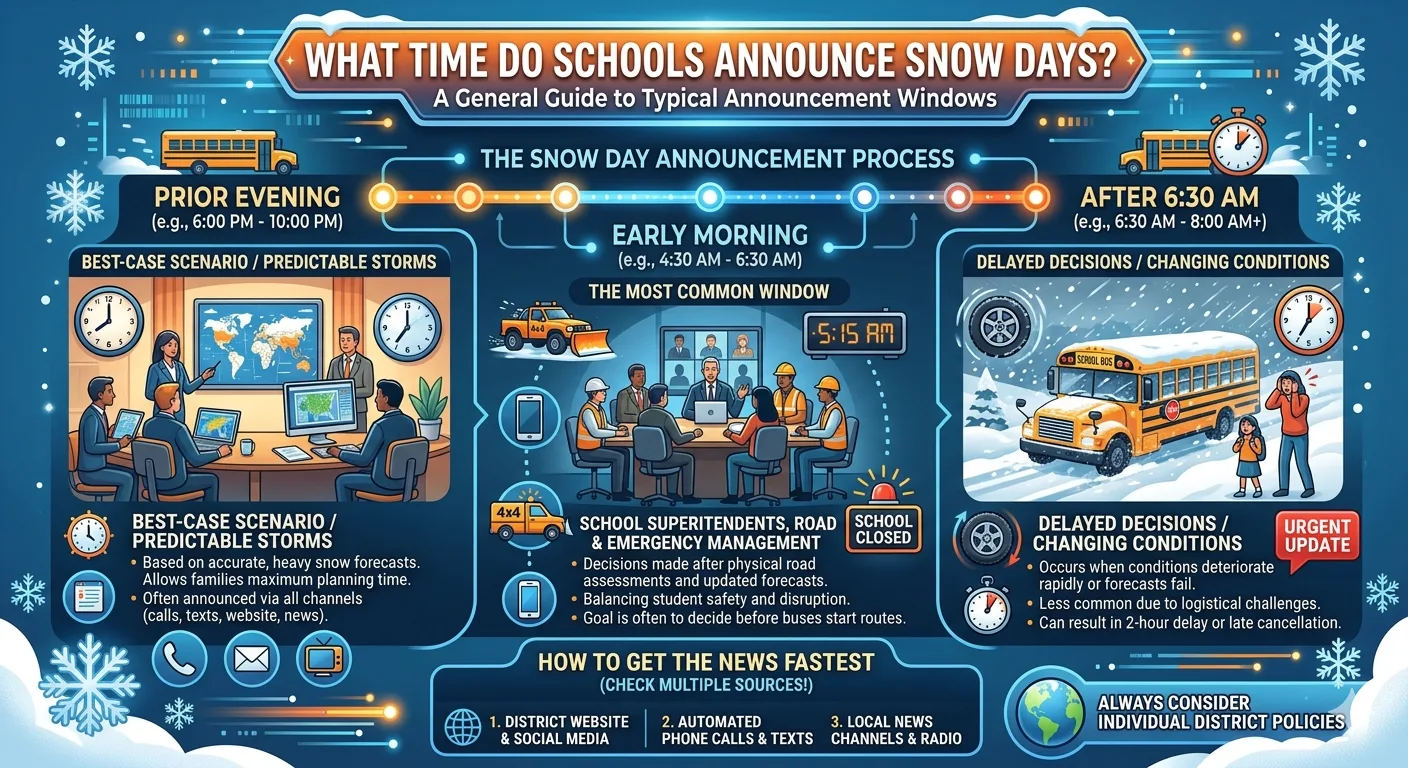
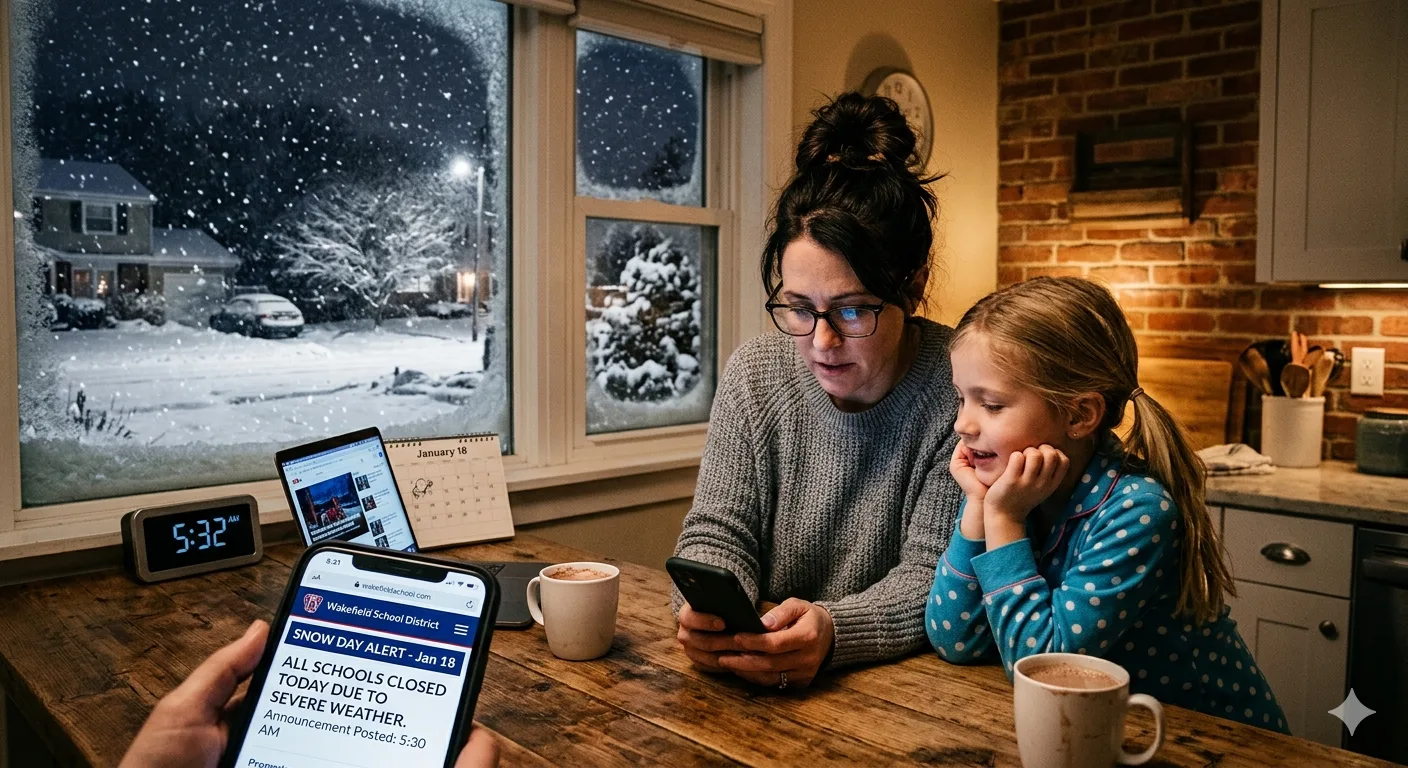
The short answer: most U.S. school districts announce snow days between 5:00 AM and 6:00 AM on the morning of the potential closure. But the full picture is far more nuanced and far more fascinating than that single window suggests. This comprehensive guide breaks down the exact timeline, the decision-making process, regional differences, and how to make sure you never miss a closure alert again.
The typical snow day announcement window is 4:30 AM to 6:00 AM. Most districts target a 5:00–5:30 AM notification to give families maximum planning time before school buses roll and morning routines begin.
The Typical Snow Day Announcement Window: By the Numbers
School closure announcements don't follow a single national standard but research across hundreds of U.S. districts reveals a consistent pattern. Understanding that pattern helps you know exactly when to check your phone on a snowy morning.
The "Night Before" Exception
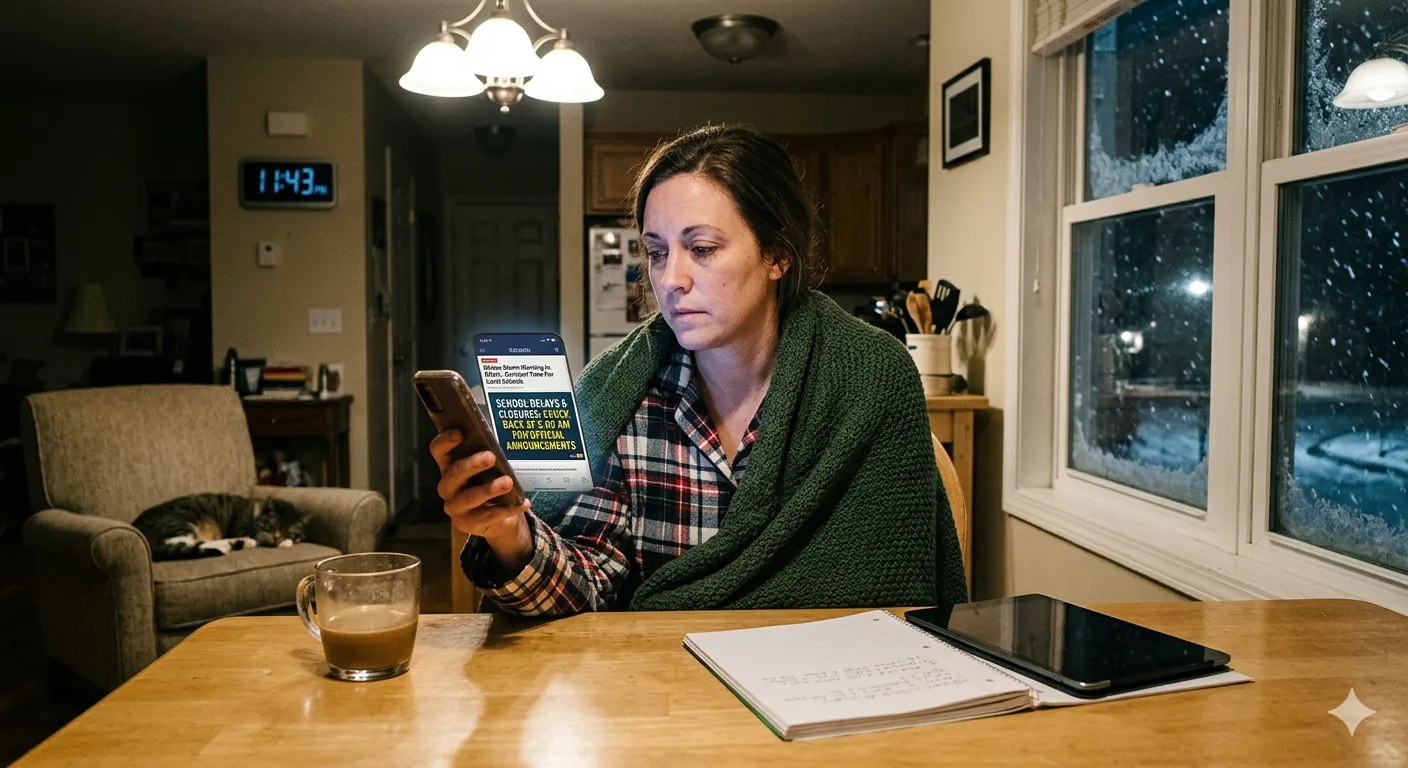
While the early-morning window is the norm, some closures are announced the evening before typically when a storm system is so clearly severe that administrators don't need real-time road assessments to make the call. Districts like Montclair Public Schools in New Jersey note that "there may be an occasion where a decision is made the night before, in which case the alert will appear at that time."
Night-before announcements are more common when a winter storm warning (not just a watch) is already in effect, forecasts show significant ice accumulation, or when the storm is expected to be at peak intensity during the early morning commute window.
Why Not Earlier? The 4:00 AM Floor
You might wonder: why don't schools just decide at midnight and let everyone sleep peacefully? The answer is data. Road conditions, snowfall rates, and temperature all change rapidly overnight. A road clear at midnight can be encased in black ice by 4:00 AM. Livonia Public Schools in Michigan explicitly states they do not place phone calls earlier than 5:00 AM, balancing data accuracy with reasonable notification time.
Who Actually Makes the Snow Day Call?
Understanding when the announcement comes requires understanding who makes the decision and what they're doing while you're still asleep.
The Superintendent: The Final Authority
In virtually every U.S. school district, the superintendent holds ultimate authority over school closure decisions. This isn't a committee vote or an automated system it's a single person weighing complex, real-time data and making a high-stakes judgment call that will affect thousands of families.
The Pre-Dawn Decision Team
By 3:30–4:00 AM on a storm morning, multiple people are already working. The superintendent rarely makes this call from a warm office they and their team are physically out in the storm.
Key players involved in the decision include:
- Transportation Director : Drives the district's most dangerous routes, performing brake tests on steep hills and icy curves
- Facilities and Maintenance Teams : Checks school boilers (often as early as 2:00 AM), parking lots, and sidewalk conditions
- Public Works / DOT : Provides real-time road treatment and condition reports
- Local Law Enforcement : Advises on major road safety
- Private Meteorologists : Many modern districts pay for specialized, hyper-local weather consulting services
- Neighboring Superintendents : Districts frequently coordinate, especially in counties where multiple school systems share bus routes or geographic challenges
The Hour-by-Hour Snow Day Decision Timeline
Here is what a typical snow day decision process looks like from the inside, based on published district protocols from Indianapolis Public Schools, Durango School District 9-R, and several Michigan districts:
Maintenance teams inspect school heating systems, boilers, and building infrastructure. A failed boiler in a single building can trigger a district-wide closure.
Transportation directors and designated "road spotters" begin physically driving bus routes not highways, but the steep hills, rural back roads, and neighborhood streets that buses must navigate.
Road reports, weather radar updates, meteorologist briefings, and public works updates are all compiled. The superintendent begins consulting with the transportation director and neighboring districts.
Indianapolis Public Schools, for example, has its deputy superintendent call the superintendent by 5:00 AM with a recommendation. The final call is made and the notification system is activated.
Automated calls, texts, and emails are triggered simultaneously. Local TV and radio stations are notified. The district website is updated. Social media posts go live.
If conditions deteriorate after an initial delay announcement, a full closure can still be called. Families who received a "2-hour delay" message should continue monitoring official channels.
What Factors Actually Trigger a Snow Day?
Snow accumulation is only one piece of a much larger puzzle. Superintendents weigh a range of interconnected factors, and some of the most surprising triggers have nothing to do with snowfall totals at all.
Ice: The #1 Fear of Every Superintendent
Experienced school administrators consistently cite ice as more dangerous than snow. A 30,000-pound school bus navigates deep snow reasonably well but a thin glaze of black ice on a curve is a different matter entirely. When forecasts show freezing rain or an ice glaze, the probability of closure jumps dramatically, sometimes approaching certainty regardless of snowfall totals.
The "Morning Crunch" Window
Timing of precipitation is as critical as amount. Snow that falls between midnight and 5:00 AM is the highest-risk scenario for schools roads are covered before plows can complete their routes, and conditions peak exactly when buses need to move. Snow that begins at 9:00 AM, after children are already in school, is far less likely to cause a closure.
Bus Route Geography
Urban and suburban districts with flat terrain, sidewalks, and heavy plow coverage can handle significantly more snow than rural districts with hilly, narrow, or unpaved roads. This is why neighboring districts sometimes make opposite decisions about the same storm: one district may be mostly flat with main-road bus routes, while another navigates steep back-country roads that simply cannot be safely plowed in time.
⚠️ Factors That Can Trigger a Snow Day Even With Minimal Snow
- Black ice : Even a small amount of freezing rain creates near-certain closure conditions
- Extreme wind chill : Most districts close when wind chills reach -15°F to -22°F (dangerous for students at bus stops)
- Boiler or building failures : Infrastructure problems unrelated to snowfall
- Power outages : Particularly district-wide connectivity failures affecting hybrid learning
- Bus driver shortages : If too many drivers can't safely commute, routes can't be covered
- Snowfall rate exceeding 1 inch/hour : Plow crews cannot keep roads clear between passes
The "Calamity Day Bank" Factor
Every school calendar is built with a predetermined number of forgiven snow days typically 5 to 10 days depending on state law. In Michigan, for example, districts can excuse up to six days for inclement weather without making them up. This creates an interesting dynamic: early in the season (December), superintendents have a full "bank" of days and may close more readily. By February or March, with the bank nearly depleted, the same storm conditions might result in a delay rather than a full closure.
Regional Differences: Does Your State Announce Earlier or Later?
Snow day timing and thresholds vary dramatically by region, reflecting local climate norms, infrastructure, and cultural expectations.
| Region | Typical Announcement Time | Snow Threshold | Decision Tendency |
|---|---|---|---|
| Northern Midwest (MI, MN, WI) | 4:30–5:15 AM | 6–10+ inches | Conservative |
| Northeast (NY, MA, CT) | 5:00–5:30 AM | 4–8 inches | Moderate |
| Mid-Atlantic (NJ, PA, MD) | 5:00–6:00 AM | 3–6 inches | Moderate |
| Southeast (GA, NC, TN) | Evening prior or 4:00–5:00 AM | 1–3 inches | Proactive |
| Mountain West (CO, UT) | 5:00–5:30 AM | Varies by altitude/terrain | Road-condition focused |
| Rural Districts (all regions) | 4:00–5:00 AM | Lower (due to road challenges) | Earlier, more cautious |
A particularly striking regional contrast: southern states like Georgia or North Carolina may cancel school for a forecast of just 1–2 inches of snow, while Minnesota districts routinely remain open through 8–10 inches because their infrastructure plows, salting equipment, and bus preparation is designed for heavy winters. As risk communication expert Dr. Gina Eosco of NOAA noted in a Weather Underground interview, "For southern states, a flake in the forecast is enough to close school."
How Schools Notify Families: Every Channel Explained
The moment the superintendent makes the call, a cascade of notifications fires across multiple channels simultaneously. Understanding each channel and which ones reach you fastest can make a significant difference in your morning preparation.
Automated Phone, Text, and Email Alerts
The fastest and most direct channel is your district's automated notification system (commonly platforms like ParentSquare, SchoolMessenger, or Blackboard Connect). These systems trigger robocalls, SMS text messages, and emails to all registered families simultaneously. The critical requirement: your contact information must be current in the district's parent portal.
District Website and App
Within minutes of the decision, districts update their official website typically with a prominent alert banner on the homepage. Many districts also have dedicated mobile apps. Indianapolis Public Schools, for example, updates its website immediately and notes that the banner will appear at the top of the homepage for any closure or delay.
Local TV and Radio Stations
School closure lists are broadcast on local TV news morning programs and radio stations. Most districts maintain formal relationships with specific media partners. In Michigan, for example, Royal Oak Schools notifies WJBK-TV (FOX 2), WDIV-TV, WXYZ-TV, and others through the Detroit Media School Closings Alliance a coordinated system that pushes all closure data to media partners simultaneously.
Social Media: The Fastest Growing Channel
Many districts now post on Twitter/X and Facebook at the same time as or even slightly before automated calls go out. Following your district's official social media accounts can give you a real-time edge. Research from Independent School Management notes that social-media-savvy districts have seen especially positive community responses when closures are announced early via these channels.
Third-Party School Closure Websites
Services like School Closing Center and regional TV station closure lists aggregate announcements from hundreds of districts in real time. These can be useful for tracking multiple districts simultaneously, though they depend on districts submitting their own data.
Delays vs. Closures: What's the Difference?
Not every bad-weather morning results in a full school cancellation. Understanding the range of possible decisions helps you plan appropriately.
Two-Hour Delay
The most common middle-ground option. A two-hour delay pushes every school schedule back by two hours including bus pickup times, building access, and class start times. This buys time for plows to clear secondary roads, de-icing crews to treat sidewalks and parking lots, and temperatures to rise slightly above the freezing threshold. Critically, a two-hour delay still counts as a full instructional day in most states, preserving the school calendar.
Full Closure
When conditions are too dangerous even for a delayed start, districts call a full closure. All in-person instruction, after-school activities, sports, clubs, and evening programs are cancelled. Students who rely on school meals and after-care programs must find alternatives.
E-Learning / Virtual Day
An increasingly common third option, e-learning days (sometimes called "asynchronous learning days" or "calamity days") allow students to complete assignments remotely. Many states have passed legislation permitting districts to count these days toward the required instructional hours, reducing the need for make-up days later. However, equity concerns students without reliable internet or devices remain a barrier to universal adoption.
Early Dismissal
When a storm develops unexpectedly during the school day, districts may call an early dismissal. Montclair Public Schools, for instance, has a policy that the superintendent monitors weather throughout the day but targets keeping schools open until regular dismissal time when possible only calling early dismissal when conditions deteriorate significantly.
The Hidden Factors Nobody Talks About
Beyond road conditions and snowfall totals, experienced superintendents weigh several less-discussed factors that can tip the scales on a close call.
Food Insecurity and Student Welfare
For many districts, closing school means some students will miss their only nutritious meal of the day. This is not a small consideration it weighs visibly on many administrators. As Northridge Superintendent David Jackson explained: "There are kids who dread breaks, because we are their stability. We provide food and care and love and acceptance, and they might not get that other places."
Parent Social Pressure and Media Influence
Superintendents are keenly aware that parents receive weather information from a wide variety of sources local TV, smartphone apps, social media that may show different forecasts. When one parent sees a "12 inches incoming" headline, pressure on the district intensifies immediately, even if the official NWS forecast is more moderate. Social pressure is a documented factor in snow day decisions, according to NOAA-affiliated risk communication research.
Staff Commuting Safety
Teachers and staff often live significant distances from their schools. Ypsilanti Community Schools Superintendent Alena Zachery-Ross notes she must consider whether employees can get to school safely not just students. If a significant portion of bus drivers or teachers cannot safely commute, school cannot operate at full capacity regardless of road conditions near the buildings.
Diesel Bus Mechanics
Diesel-powered school buses must sit on block heaters during extreme cold to ensure they start. In districts with many older buses, mechanics may come in hours before school to run diagnostics. If a significant portion of the fleet cannot start, a closure becomes necessary even if roads are passable.
Read More : How Accurate Is the Snow Day Calculator?
How to Make Sure You Never Miss a Snow Day Announcement
Even the most timely district announcement is useless if it doesn't reach you. Here is a practical system for ensuring you're always the first to know:
- Update your contact info in the district parent portal : Do this every August before the school year begins. Check that your primary phone, backup phone, and email are all current and opted into emergency alerts.
- Follow the district's official social media accounts : Twitter/X and Facebook pages for your school and district often post at the same time as automated alerts.
- Bookmark the district website : Most homepage closures appear as pop-up banners or top-of-page alerts immediately after the decision is made.
- Enable push notifications on the district's app : If your district has a parent-facing app (many use Remind, ParentSquare, or Schoology), turn on push notifications specifically for emergency alerts.
- Tune local TV or radio at 5:00 AM during storms : Morning news programs actively broadcast running closure lists during severe weather events.
- Check a regional school closure aggregator : Sites like your local TV station's closure page often update the moment a district submits its data.
- Know your district's specific policy ; Some districts explicitly state they will never call before 5:00 AM; others may call as early as 4:30 AM. Reading your district's official weather policy page takes five minutes and saves confusion all winter.
What Happens to Make-Up Days?
Every closure raises the question of what comes next specifically, when and how those lost instructional hours are recovered.
State-Mandated Instructional Requirements
Most U.S. states require schools to complete 180 instructional days or 900–1,080 instructional hours per year. School calendars are typically built with a buffer of 3–7 "snow days" already accounted for. As long as closures stay within that buffer, no make-up is required.
When the Buffer Is Exceeded
If a district exceeds its allotted emergency days, make-up options typically include: using previously scheduled vacation days (spring break, teacher professional development days), extending the school year into June, or applying for a state waiver. In Michigan, for example, districts can excuse up to six days by law, and must apply to the State Superintendent for additional forgiveness if exceeded.
The E-Learning Alternative
Increasingly, states are allowing districts to count e-learning days toward instructional requirements, essentially eliminating make-up days for districts with approved remote learning plans. Minnesota's statute 120A.414, for example, provides a legal framework for e-learning days as a direct substitute for in-person instruction during inclement weather.
Conclusion: Set Your Alarm for 5:00 AM
The next time a winter storm looms on the forecast, you now know exactly what is happening while you sleep. By 3:30 AM, transportation directors are out driving icy back roads. By 4:45 AM, the superintendent is on the phone reviewing all available data. By 5:00–5:30 AM, the decision is made and notifications fire simultaneously across every channel.
The single most important thing you can do right now is verify that your contact information is current in your district's parent portal before the next storm hits. A perfectly timed announcement means nothing if it's going to an old phone number or an unmonitored email address.
Snow days are not arbitrary or capricious decisions. They represent the output of a sophisticated, real-time logistics operation carried out by dedicated administrators who wake before dawn to drive icy roads so your children don't have to. Understanding that process doesn't just answer "what time do schools announce snow days" it gives you genuine insight into the remarkable care that goes into every single closure decision.